


Nanomer® I.22E
General Information:
Nanomer® I.22E nanoclay is a modified montmorillonite mineral which is formulated for anhydride- cured epoxy resins. When properly dispersed, I.22E creates a near-molecule blend commonly known as a nanocomposite. This new type of composite enhances strength and thermal properties, especially glass transition temperature (Tg). Nanomer I.22E nanoclay is supplied as a white powder which disperses to particles so thin they are nearly transparent in the resin system. For more information about Nanomer structure and dispersion mechanism consult Tech Data G-100.
Loading Levels:
Unlike conventional mineral fillers, Nanomer nanoclays enhance performance at low loading, generally 10-25 phr. This unique feature allows for improved performance at minimal added weight.
Viscosity:
I.22E is preferred when mixing and/or curing must be done at lower viscosity. Table 1 gives typical viscosity data for low and high recommended loadings.
TABLE 1
Resin |
Curing Agent |
Nanoclay (phr) |
RPM 10 |
RPM 30 |
RPM 50 |
|
|
0 |
740 cps |
740 cps |
740 cps |
EPON®828 |
ECA® 100 |
10 |
850 cps |
830 cps |
830 cps |
|
|
25 |
1250 cps |
1200 cps |
1150 cps |
* Brookfield Model RV DV III, spindle # 3. All viscosities measured at 230C.
Suspension Stability:
Stability varies inversely with viscosity. I.22E forms a semi-stable system. Full stability will be maintained for 18-24 hours depending upon loading. Although the dispersion will “drop” over time, it will not hard-pack and can be reconstituted. If permanent stability is required I.28E should be used. However, I.28E will increase system viscosity and higher shear mixing equipment should be considered.
Strength Properties:
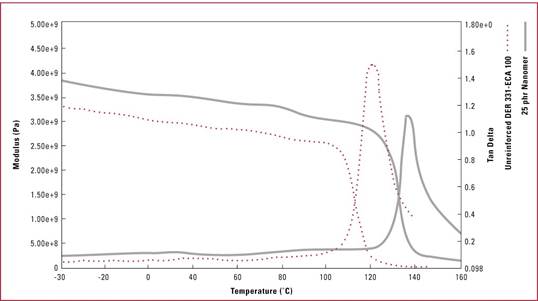
Epoxy nanocomposites exhibit improved mechanical properties due to reinforcing effects. Generally, the magnitude of improvement is larger in the region above the Tg. Figure 1 presents the DMA for neat epoxy and the corresponding nanocomposite at 25 phr loading.
Glass Transition:
I.22E creates a new, more interlinked structure in epoxy matrices. This is most apparent in the Tg. Increases of 10 - 200C are common. Although Tg increases with increased loading, most of the benefit is seen at the low end of the recommended range. A 10 phr loading usually produces 90% of the Tg improvement possible.
Nanoclay Incorporation:
I.22E can be dispersed into the resin, curing agent or a combination of the two. Although it is easy to disperse, some simple guidelines must be followed. For detailed information consult Tech Date T-15.
Curing Accelerators:
2E accelerates curing to a moderate extent. Usually no additional curing accelerates are needed. I.22E is compatible with most common accelerators, should you feel one is desirable.
PHYSICAL PROPERTIES
Appearance |
White Powder |
Mean Dry Particle Size (microns) |
8-10 |
+ 325 Mesh Residue (%) |
0.1 |
Specific Gravity |
1.9 |
Bulk Density (pounds/ft3) |
25 |
Moisture (%) |
3 max |
Mineral Purity (% min) |
98.5 |
Product Availability:
Nanomer I.22E nanoclay is available in 20 kg (44 lb.) polylined bags or fiber drums.
Figure 1 – Storage Modulus
 |
For more information on how Nanomer® nanoclays can work for you, contact Nanocor’s TechnicalService Group. â Nanomer is a registered trademark of Nanocor, Inc